
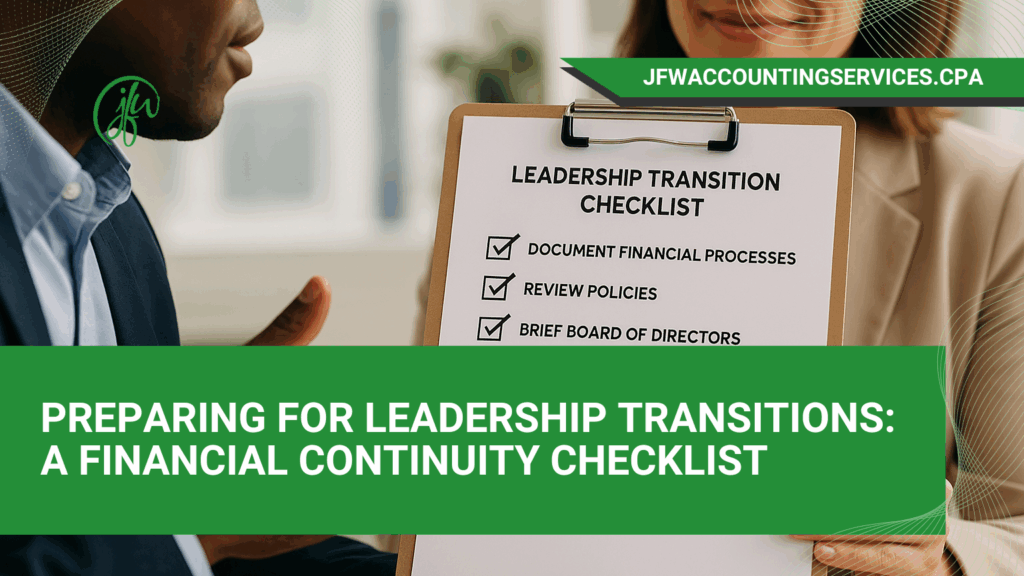
If your nonprofit is preparing for a leadership transition, our team can help you turn this checklist into a practical, 90-day financial continuity plan. Contact us to identify potential gaps, protect your processes, and support a smoother handoff.
When your nonprofit’s Executive Director announces their departure or a Finance Director accepts a new position, the clock starts ticking. Nonprofit organizations face a narrow window to protect years of institutional knowledge, maintain donor confidence, and keep financial operations stable during the handoff.
Leadership transitions happen frequently in the nonprofit sector. BoardSource research shows that executive turnover affects organizations of all sizes, often with little advance notice. The challenge extends beyond finding the right replacement—all with the intention of quickly and confidently preserving the financial systems, relationships, and processes that keep your organization running.
Document Everything Before the Exit
The first step is to conduct a complete audit of financial responsibilities and access points. Create a master list that includes every bank account, credit card, software login, vendor relationship, and signature authority. This inventory often reveals gaps that existed long before the transition began.
Outgoing leaders should document their monthly routines, quarterly tasks, and annual deadlines. The goal here is to capture not just what gets done, but also why certain decisions were made, and which stakeholders need regular updates. This knowledge transfer prevents the new leader from starting at zero, and prevents essential communication channels from disappearing.
Next, it’s important to review your chart of accounts and any customized coding structures. If your organization uses specific fund codes for different programs or grants, make sure to document the logic behind these categories. The departing leader understands why certain transactions flow to particular accounts—that reasoning must be recorded before they leave.
Strengthen Your Standard Operating Procedures
Among their many benefits, Standard Operating Procedures (SOPs) protect organizations when people leave. They turn individual expertise into organizational assets. Start with the financial close process, documenting each step from transaction entry through final reconciliation.
Detail your accounts payable workflow, including approval thresholds, payment timing, and vendor communication protocols. Map out accounts receivable procedures, particularly for membership dues, program fees, or pledged donations. Include information about which funders require specific invoicing formats or reports.
Grant management deserves special attention during transitions. Document each active grant’s reporting requirements, spending restrictions, and key contact information. The National Council of Nonprofits provides resources on grant compliance that can help ensure nothing falls through the cracks during leadership changes.
Additionally, you should make sure that you have detailed written procedures for payroll processing, benefit administration, and tax filing deadlines. These functions cannot pause during a transition, which could happen at any time of the year, so documentation needs to be thorough enough that someone unfamiliar with your systems could follow the steps.
Build Financial Transparency Into the Transition
Board members in particular need clear visibility during leadership changes. To help prevent any disconnect, we find it helpful to schedule a financial briefing before the outgoing leader’s last day, covering the organization’s current position, upcoming obligations, and any concerns that require board attention.
To help make the information being passed on as easy to follow as possible, your outgoing leader should prepare a transition memo that summarizes the fiscal year to date, highlights any unusual transactions or timing issues, and flags upcoming deadlines. This document becomes a reference point for both the incoming leader and the board’s finance committee.
Finally, don’t forget to review your financial policies to confirm they remain current and accessible. Policies on expense reimbursement, procurement, investment management, and reserve funds should be clearly written and easy to locate. The incoming leader will need these guidelines immediately
Maintain External Relationships
Financial transitions also affect relationships beyond the organization. With this in mind, you should schedule handoff meetings with your auditor, bookkeeper, payroll provider, and banking representatives. During these conversations, you may also want to introduce the incoming leader if they’re already on board, or designate an interim contact who can maintain these relationships.
You will also want to notify funders about leadership changes according to their requirements. Some grants include provisions about key personnel changes, and proactive communication helps maintain trust. In these communications, make sure to share information about the transition timeline and confirm that grant reporting will continue without interruption.
It’s important to also make sure that you update signature cards at financial institutions and adjust authorization levels for online banking and payment systems. This administrative work takes time but prevents access problems later.
Plan for Knowledge Overlap
The most effective transitions include a period where outgoing and incoming leaders work together. Even a few days of overlap allows the new leader to observe financial processes, ask questions, and understand organizational priorities.
If overlap isn’t possible, identify someone internal who can bridge the gap. In many cases, this might be a Finance Manager, Development Director, or experienced board member who knows the organization’s financial operations. Their involvement provides continuity while the new leader gets oriented.
You may also consider bringing in external support during the transition period. Organizations working with experienced accounting partners often find that outside expertise helps stabilize operations when internal knowledge walks out the door.
Protect Your Financial Data and Systems
Transitions create vulnerability in data security, and you’ll want to remember to update certain password protocols and review who has access to financial systems.
Additional security measures should also include:
- Removing departing staff from bank accounts, credit cards, and software platforms promptly
- Backing up financial data before the transition begins.
- Storing copies securely and confirming that multiple people know how to access them if needed.
- Thoroughly testing your backup systems to verify they actually work.
- Document your technology stack, including which platforms integrate with each other and where data flows between systems.
All of this information helps the incoming leader understand how financial information moves through the organization, and also helps protect the data security and reputation of your organization
Create a 90-Day Financial Roadmap
Once the documentation is in place, pull everything together into a clear 90-day financial roadmap for the incoming leader. The goal is to show, at a glance, what matters most in the first three months.
Start by building a calendar of key dates: monthly close deadlines, board and finance committee meetings, grant and funder reporting due dates, payroll cycles, and any known filing requirements. Having these time-sensitive tasks in one place helps the new leader prioritize and reduces the risk of missed obligations.
Add context around your organization’s financial rhythm. Note months when cash typically runs tight, when major grants are awarded or renewed, and when program revenue tends to spike or dip. This gives the new leader a realistic view of what’s “normal” versus what might signal a problem.
Finally, review your financial reporting package with the transition in mind. Confirm that reports are clear, decision-ready, and aligned with how the new leader prefers to consume information. They may need more narrative explanations at first, or a temporary focus on a smaller set of core metrics while they get up to speed.
Leadership transitions test an organization’s financial foundation. The nonprofits that navigate these changes well share a common trait: they build systems and documentation that outlast any individual leader. Financial continuity isn’t about preventing change; it’s about ensuring change doesn’t derail the mission.
If your organization is anticipating a nonprofit leadership transition—or is already in the middle of one—it can be helpful to have an outside partner review your processes, identify gaps, and turn this checklist into a practical 90-day financial plan. JFW Accounting Services works alongside boards, Executive Directors, and finance teams to document workflows, strengthen controls, and create reporting that supports a smooth handoff and long-term stability.
Contact us today to see how we can help you!

Jo-Anne Williams Barnes, is a Certified Public Accountant (CPA) and Chartered Global Management Accountant (CGMA) holding a Master’s of Science in Accounting (MSA) and a Master’s in Business Administration (MBA). Additionally, she holds a Bachelor of Science (BS) in Accounting from the University of Baltimore and is a seasoned accounting professional with several years of experience in the field of managing financial records for non-profits, small, medium, and large businesses. Jo-Anne is a certified Sage Intacct Accounting and Implementation Specialist, a certified QuickBooks ProAdvisor, an AICPA Not-for-Profit Certificate II holder, and Standard for Excellence Licensed Consultant. Additionally, Jo-Anne is a member of American Institute of Certified Public Accountant (AICPA), Maryland Association of Certified Public Accountants (MACPA), and Greater Washington Society of Certified Public Accountants (GWSCPA) where she continues to keep abreast on the latest industry trends and changes.